This office is the body responsible for promoting priestly vocations within the diocese, supporting individuals who wish to discern their vocation, and overseeing those who seek to enter the seminary, preparing them for admission in coordination with the Rector of the Seminary and the formation team of priests. The office is directed by the Vocations Director or Directors of the diocese.
The work of this office extends throughout all parts of the diocese; however, its main offices are located at the Patriarchal Vicariate in Amman and at the Patriarchal Seminary in Beit Jala. Its work relies primarily on visiting parishes, schools, and pastoral activities in order to promote the importance of understanding vocation in the lives of young people.
The specific goal of this office is to discern the vocation of men who feel that God is calling them to live holiness in their lives through dedicating themselves to the Lord in the sacred priesthood, and to determine whether this is indeed the path through which the Lord calls them to live their particular vocation to holiness. It also collaborates with other religious orders to promote a broader understanding of vocation among all groups.
The Role of the Vocations Office
The role of the Vocations Office can be summarized in three main areas:
1) The Awareness Role
This involves reminding people of all backgrounds and ages of the importance of following God’s voice in their lives, and promoting this concept in youth pastoral activities, schools, and even among parents, who play a significant role in fostering and supporting vocations in their children. This is carried out through:
Organizing activities aimed at raising awareness about vocations and the importance of discovering them, such as vocation meetings, vocation camps, etc.
Participating in pastoral liturgies and general awareness initiatives about the concept of vocation.
Taking part in meetings of youth movements (the General Secretariat for Youth, the General Scout Association).
Participating in pastoral, youth, and non-youth group meetings to create general awareness among young people, parents, and the faithful at large.
Conducting awareness visits to schools and participating in Christian education classes or other school-based activities.
Promoting awareness about vocations through social media platforms.
Collaborating with school administrations and the Office of Christian Education, especially with Christian education teachers and religious sisters, who can help identify vocations among young people at an early age.
2) The Guidance Role
This consists of supporting personal discernment for individuals seeking to discover their vocation; providing spiritual guidance and counseling for those considering priestly or religious life; accompanying, evaluating, and preparing candidates who wish to enter the seminary; recommending candidates for seminary admission and submitting reports about them; and organizing spiritual retreats and discernment programs with specialists to help individuals better understand their vocation.
3) The Interactive Role
Since the Vocations Office cannot cover all parts of the diocese simultaneously, other offices and movements within the diocese play an essential role in meeting its needs:
With Parish Priests:
Parish priests play a major—indeed primary—role in discerning vocations (cf. Can. 233 §1). Their role is not limited to granting approval for those wishing to join vocation programs; rather, they play a pivotal role in initially identifying and discerning these vocations. Regarding school students, the role of the parish priest is to preserve, nurture, and guide these vocations until the individual is ready to join the vocation program at the appropriate time. The greatest role of parish priests lies in reminding the faithful to pray for priestly vocations, celebrating Masses for this intention on specific occasions, and offering times of Eucharistic adoration in parishes for this purpose.
With Youth Movements:
Engaging the Vocations Office in youth events and celebrations such as the Feast of Christ the King, summer camps, training courses, etc.; coordinating with youth leaders to organize meetings and celebrations focused on vocation discernment; and collaborating with youth leaders by participating in their activities and allocating time within them to speak about vocations, or at least being present.
With the Seminary:
Maintaining continuous communication with the Seminary Rector and the formation team to ensure open channels for addressing any challenges or issues faced by candidates; collaborating with the seminary in evaluating candidates prior to admission to ensure their spiritual, academic, and psychological readiness for priestly formation; and organizing joint activities and events, given the seminary’s vital role in fostering priestly vocations.
The Logo of the Vocations Office
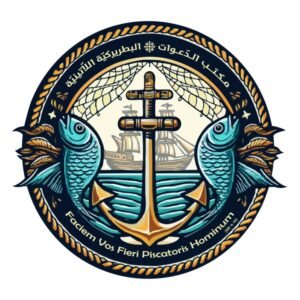
The logo is inspired by the calling of the first disciples on the shore of the Sea of Galilee. When Jesus called His disciples, He entrusted them with the mission of becoming “fishers of men,” meaning that their primary task after being called was to invite others to follow Christ. This verse was chosen as the motto of the office because it reflects its mission of accompanying those discerning their vocation, discerning vocations with them, supporting them, and raising awareness among the faithful of the importance of following God’s call.
Symbolism of the Logo
The Anchor Intertwined with the Patriarchal Cross:
In Christian tradition, the anchor symbolizes firm hope in God. It is used as a symbol of spiritual stability and steadfastness amid challenges (Hebrews 6:19), where hope in Christ is seen as an anchor that keeps believers firm in their faith, especially during storms. Its integration with the Patriarchal Cross from above represents the hope of the Patriarchal Church for continuous and renewed vocations sent by the Lord to His Church.
Maritime Elements:
In the background, three elements aligned with the maritime theme appear:
The Sea: Represents the world, a world full of turmoil and waves.
The Ship: Represents the Church, which sails through the world and protects believers from storms and hardships.
The Net: Symbolizes the call of believers to evangelize and gather people into the Kingdom of God. It also represents the role of the Vocations Office in “catching” new vocations to serve the Lord.
The Rope Border:
The outer border is designed in the form of a rope, consistent with the maritime theme. The rope symbolizes the spiritual bond and the connection between God and believers. In the logo, it also represents unity and strength, bringing together all members of the Church—laity and consecrated alike—to work for vocations.
The Two Fish:
Fish hold significant meaning in Christian symbolism. They were used as an early symbol representing Christ and served as a secret sign of faith in the early centuries of Christianity. In the logo, the fish represent the followers of Christ, pointing to Jesus’ call to His disciples to become “fishers of men” (Matthew 4:19).
“All media and content are the property of the Latin Patriarchate and are intended for public informational use.
© 2026 Latin Patriarchate – Jordan.”