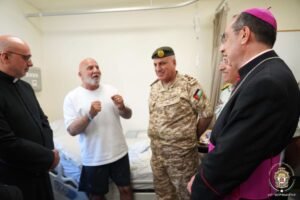
The recent attack in Hamoud has brought deep sorrow to our nation. My prayers remain with the victims, their families, and everyone affected by this senseless violence. As a pastor, I have seen the pain and anxiety it has caused. But I have also witnessed something powerful: Jordanians from every background reaching out to one another with compassion and solidarity.
In the days that followed, observers outside Jordan noticed the firm response of the country’s leadership, the support expressed by Muslim leaders and institutions, and the genuine concern shown throughout society. For those of us who live here, however, this response felt familiar. It reflected the Jordan we know in our everyday lives.
As a bishop serving the Catholic Church in Jordan, I do not see Christians as standing apart from the rest of society. We are part of Jordan’s history, its present, and its future. When Jordan rejoices, we rejoice. When Jordan suffers, we suffer. The grief caused by this attack was neither Christian nor Muslim. It was Jordanian.
This sense of belonging has grown from a long tradition of shared citizenship. Christians and Muslims in Jordan do more than live alongside one another. We work together, educate our children together, serve our communities, and help shape the country’s future. We share many of the same hopes and challenges, as well as the same responsibility for the common good.
I often tell visitors that shared citizenship in Jordan cannot be understood through laws and official statements alone. It must be lived. You see it in the friendships between families, in classrooms where Christian and Muslim children grow up together, and in workplaces where colleagues share the responsibilities of daily life. You also see it in neighborhoods where people stand beside one another in moments of joy and sorrow.
This was the spirit we saw after the Hamoud attack. His Majesty King Abdullah II immediately condemned the violence. State institutions expressed their support, and religious leaders across the country rejected the attack. These were more than official responses. They reflected a conviction held by countless Jordanians: every human life has dignity, and violence committed in the name of religion betrays the values that religion should uphold.
For Christians, this solidarity offered more than reassurance. It reminded us of our place within the national family. We did not feel that sympathy was being offered to a separate or isolated community. We felt the support of fellow citizens who understood that an attack against any member of society wounds the whole nation.
For the Church, this is not only a social achievement. It is also a spiritual responsibility. Our faith teaches us that every person is created in the image and likeness of God. Defending human dignity, encouraging mutual respect, and strengthening harmony within society are therefore essential parts of our Christian mission.
The Catholic Church seeks to serve Jordan not only through worship but also through education, healthcare, charitable work, and other forms of service. Our schools educate thousands of young Jordanians, most of whom are Muslim. Our charitable institutions, healthcare ministries, and social programmes serve families without distinction. Every day, priests, religious sisters, educators, volunteers, and laypeople work quietly to strengthen the relationships that hold our communities together.
For us, this is more than social work. It is a living witness to the Gospel. We believe faith should build bridges, not walls. Authentic religious belief should bring people closer together, not push them apart.
Of course, Jordan is not free from challenges. Like the rest of the region, we face economic pressure, migration, demographic change, and the uncertainty created by surrounding conflicts.
Nor do we claim that Jordan is a perfect society or that Christians never experience difficulties. Like every society, ours has moments of misunderstanding, sensitivity, and concern. Christians sometimes worry about public representation, equal opportunities, emigration, and the preservation of their presence and heritage. Social attitudes may also develop more slowly than the principles expressed in our laws and institutions.
We must be honest about these concerns. Genuine shared citizenship is not built by pretending that difficulties do not exist. It grows when we face them together, with mutual respect and a shared sense of responsibility for our country.
Social harmony can never be taken for granted. It requires constant care. We must renew it through education, dialogue, responsible leadership, justice, and a lasting commitment to the common good.
What gives me hope is the resilience of ordinary Jordanians. Time and again, they have refused to allow fear and division to prevail. They continue to choose respect over hatred, solidarity over suspicion, and national unity over sectarianism.
The days following the Hamoud attack reminded me of something I have learned throughout my ministry: Jordan’s strength lies not only in its institutions, but also in the character of its people. When it matters most, Jordanians choose to stand together.
As Christians, we are deeply grateful for this reality, but we do not take it for granted. We see it as both a blessing and a responsibility. We must continue serving the common good, creating a culture of encounter, and helping younger generations preserve the values that have made shared citizenship possible.
The Middle East is often described only through stories of conflict and division. Jordan offers another story. It shows that people of different faiths can remain faithful to their religious traditions while sharing a national identity, a responsibility toward one another, and a common future.
Jordan’s experience matters not because it is perfect, but because it shows that differences and challenges do not have to end in division. Despite occasional tensions and difficulties, Jordanians have repeatedly chosen to address their concerns within a shared national identity and a common commitment to the country’s future.
Security is essential in confronting terrorism, but security alone is not enough. The strongest response to violence is ordinary people’s determination to remain neighbours, friends, and fellow citizens. We saw that determination after the attack in Hamoud, and it remains one of the greatest sources of hope for Jordan’s future.
As Jordanians, Christians and Muslims alike, we mourn together, stand together, and build together. This is the true meaning of shared citizenship. It is more than a political idea. It is a way of life and one of Jordan’s most precious gifts to the region: peace and justice.
+ Bishop Iyad Twal
Patriarchal Vicar in Jordan and Auxiliary Bishop in the Latin Patriarchate